
Scam Guides
How to protect your parents from WhatsApp scams
The stories keep changing, but the pattern repeats: an unknown number, pressure to act now, and a request for money or a code. This guide covers the scams reaching parents right now, the warning signs, and what to do.
The scams to know about right now
Digital arrest (India)
A caller on a WhatsApp video call claims to be from the police, the CBI or the ED and says the victim is under "digital arrest". India's cybercrime coordination centre (I4C) says these agencies do not arrest anyone over a video call [1]. The Ministry of Home Affairs said I4C had identified and blocked 3,962 Skype IDs and 83,668 WhatsApp accounts used in these scams [2]. In January 2026 an elderly Delhi couple was reported to have lost nearly ₹14 crore [3], and an elderly woman in Karnataka was reported to have lost ₹3.09 crore [4].
The fake relative and the "new number"
A message arrives from a friend or relative, but it comes from a cloned or fake profile with their name and photo, and it asks for money, for example to pay for a phone or car repair. Canaltech's advice is to check with another family member and to confirm the request directly with the person [5]. Febraban, the Brazilian banks' federation, has published a list of the main Pix scams [6].
AI voice clones
Scammers can copy a voice from a short clip and phone a parent as a grandchild or relative in trouble. The US Federal Trade Commission has warned about it [7]. In October 2026 a 69-year-old in Mumbai was allegedly cheated of ₹50 lakh after a caller with a cloned voice impersonated a respected community figure [8], and a Himachal man lost ₹2 lakh after a call he believed was from his uncle [9]. The Tamil Nadu cybercrime wing has issued an advisory [10].
The same trick works on bosses. A bank manager in the UAE moved about $35 million after a call from a voice cloned from a company director he knew, according to US court documents reported by Forbes [11]. If a bank manager can be fooled, a parent can be.
Deepfake video calls
Faces can be faked on video too. An employee of the engineering firm Arup in Hong Kong joined a video meeting where the finance chief and colleagues were all deepfakes, and made 15 transfers worth about US$25.6 million [12]. A Bengaluru chartered accountant was reported to have lost ₹23 lakh to a deepfake video scam [13]. The FBI has also warned of AI-generated voice messages impersonating senior US officials [14].
Fake celebrity and minister endorsements
A 76-year-old man in Belagavi, Karnataka, lost ₹7.9 lakh after a YouTube deepfake video of India's Finance Minister endorsed an investment scheme, and police registered a case on 1 May 2026 [15]. In Brazil, deepfake videos used the voice and face of the singer Roberto Carlos, aged 85, to sell "miracle" medicines, and the actress Fernanda Montenegro was targeted too [16].
Warning signs that appear in almost every scam
- A call or message from a number they do not know, or a "new number" for someone they do.
- Pressure to act at once, and a request for money or a code. Always stay careful with OTPs and money.
- A claim to be an official on WhatsApp. India's I4C says CBI, ED and the police do not arrest people over video calls [1].
- A voice that sounds like someone they know, with a story that cannot wait. Voices can be cloned, so a familiar voice proves nothing [7].
What to do straight away
- Hang up. If someone urgently demands money, call the person back on the number you normally use for them, even if the voice sounds like theirs [7].
- If you cannot reach them, call another trusted person to confirm they are safe [7].
- Do not send money or share codes while someone is on the line.
- Tell someone in the family.
- Report it. In India call 1930. In Brazil talk to your bank and report it through SaferNet.
- Think about what you post. Long public videos with your voice and image can be reused to imitate you [7].
How Scam Rakshak helps
Scam Rakshak watches WhatsApp activity for the patterns scammers use. It does not read messages or listen to calls. Once protection is turned on, it works quietly in the background and alerts you only when it detects signs of a potential scam.
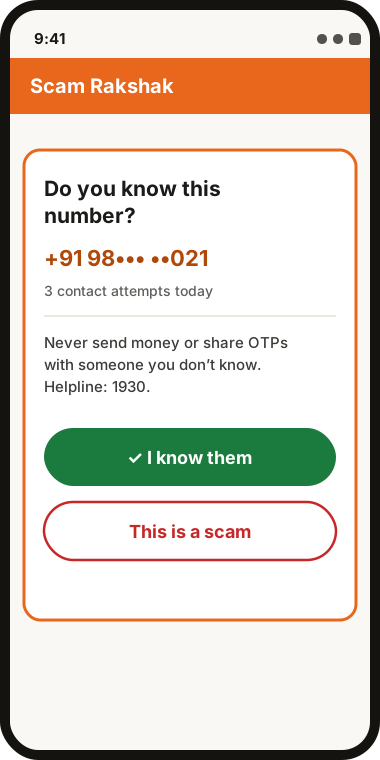
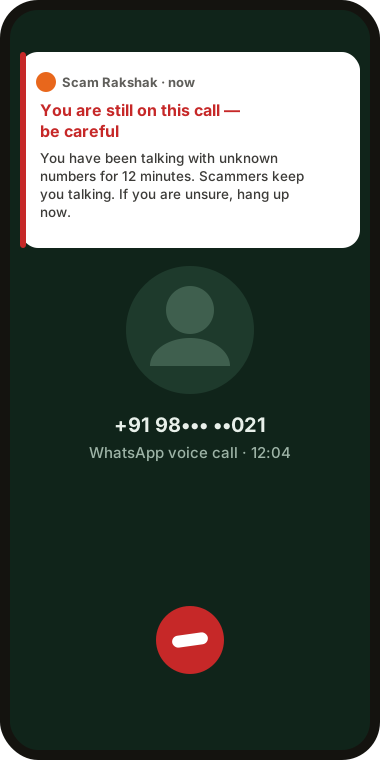
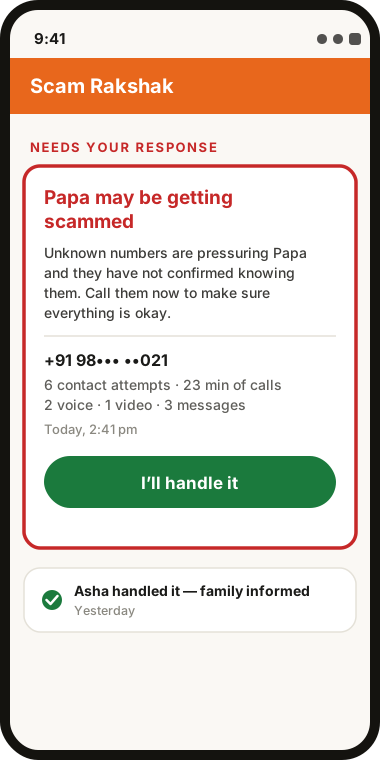
Protection for seniors is free. Scam Rakshak cannot stop every scam, so the steps above still matter.
Get it on Google Play See how it works
More scams
There are more guides, by country and by type: India, Brazil, AI Scams and Worldwide. Browse all Scam Guides →
Sources
- ETV Bharat on the I4C advisory
- PIB, Ministry of Home Affairs (March 2025)
- Business Today (13 January 2026)
- Deccan Herald
- Canaltech
- Tecnoblog sobre a lista da Febraban
- KUTV on the FTC warning
- Free Press Journal (15 October 2026)
- The Tribune
- MediaNama on the Tamil Nadu cybercrime advisory
- AI Business (19 October 2021)
- Fortune (17 May 2024)
- Deccan Herald
- FBI IC3 alert (15 May 2025)
- ThreatCluster, from Deccan Chronicle (May 2026)
- Band (21 de julho de 2026)
Cases are as reported by the outlets linked above. Amounts and details are theirs, not ours. Blu Codeworks is an independent Australian software studio. Scam Rakshak helps protect seniors by detecting signs of scams. It cannot stop every scam.